
All Scholars
DUCKWORTH, George Eckel
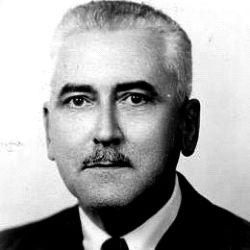
- Date of Birth: February 13, 1903
- Born City: Little York
- Born State/Country: NJ
- Parents: Edwin James & Eva Eckel D.
- Date of Death: April 05, 1972
- Death City: Princeton
- Death State/Country: NJ
- Married: Dorothy Ellwood Atkin, 8 July 1929.
- Education:
A.B. Princeton, 1924; A.M., 1926; Ph.D., 1931.
- Dissertation:
“Foreshadowing and Suspense in the Epics of Homer, Apollonius, and Virgil” (Princeton, 1931); printed (New York, 1933).
- Professional Experience:
Instr. class. Princeton 1924-5; U. Nebraska, 1926-8; instr. to prof. Princeton, 1928-71; actng. chair class, dept., 1943-6; Giger Prof, class., 1946-71; trustee AAR, 1947-59; prof.-in-charge ASCS AAR, summers 1952-6; pres. APA, 1955-6; vis. prof. Harvard, 1955-6; Guggenheim Fell., 1957-8; vis. sch. Univ. Center in Virginia, 1958.
- Publications:
“Προαναφώνησις in the Scholia to Homer,” AJP 52 (1931) 320-38; “Foreshadowing and Suspense in the Posthomerica of Quintus of Smyrna,” AJP 57 (1936) 58-86; “The Dramatic Function of the servus currens in Roman Comedy,” Studies Capps, 93-102; “The Unnamed Characters in the Plays of Plautus,” CP 33 (1938) 267-82; “The Structure of the Miles Gloriosus,” CP 30 (1935) 228-46; “The Chronology of T. Macci Plauti Epidicus (Princeton, 1940); The Complete Roman Drama, 2 vols. (New York, 1942); The Nature of Roman Comedy (Princeton, 1952); “The Architecture of the Aeneid,” AJP 75 (1954) 1-15; “Plautus and the Basilica Aemilia,” Ut Pictura Poesis: Studia Latino, Petro Iohanni Enk Septuagenario Oblata (Leiden, 1955) 58-65; “Animae Dimidium Meae: Two Poets of Rome,” TAPA 87 (1956) 281-316; “Vergil's Georgics and the Laudes Galli,” AJP 80 (1959) 225-37; “Turnus and Duryodhana,” TAPA 92 (1961) 81-127; Structural Patterns and Proportions in Vergil's Aeneid (Ann Arbor, 1962); Roman Comedies: An Anthology (New York, 1963); “The Significance of Nisus and Euryalus for the Aeneid IX-XII,” AJP 88 (1967) 129-50; “A Rare Type of First-Foot Dactyl (Three Words),” AJP 89 (1968) 437-8; Vergil and Classical Hexameter Poetry (Ann Arbor, 1969). Bibliographic surveys: Vergilius 2(1939) 38-40; 3 (1939) 33-4; 4 (1940) 44-5; 6 (1941) 49-50; “Recent Work on Vergil, 1940-1956” CW 51 (1957-8) 89-92, 116-7; 123-8, 151-9; 185; 193; 228-35; “Recent Work on Vergil, 1957-1962” CW57 (1963-4) 193-228.
- Notes:
George Duckworth was noted as a humane and learned teacher who began his career chiefly as an instructor in Greek, later shifting mostly to Latin (prompted in part, he used to claim, by being once introduced to an audience as “a man who knows his Greek from alpha to zeta”). He was the author of seven books and over fifty articles. He is best known for his work on Roman comedy, particularly Plautus, a standard work on the subject that contained information and fair representations of arguments on either side of the many questions surrounding sources and performance of Roman Comedy. In the 1960s, before computers were involved in humanities research, Duckworth manually scanned every line of Latin hexameter poetry to show favorite combinations of dactyls and spondees in the first four feet of the line in all Latin poets. He had begun the project by working on Virgil's metrics (he contributed several useful surveys of Vergilian scholarship) and discovered to his satisfaction that not only Virgil's poetry but all Latin poetry was based on the Golden Proportion, the notion that a smaller portion of an object tis to the larger portion as the larger portion is to the whole. This is expressed numerically as 1.618 and it was not long before Classics students at Princeton wore t-shirts that said, "Altertumswissenschaft=1.618." Duckworth was, in the words of his student Karl Galinsky, "a 'professor' in the best tradition: he had his own bent of mind and therefore encouraged others to develop their own; he never stopped working and looking out for new horizons; and he was both authoritative and humane."
- Sources:
CW 66 (1972-3) 77-9; George E. Duckworth: A Bibliography (Princeton, 1971); NYTimes (6 Apr. 1972); WhAm 5:198' ; Karl Galinsky, “George Eckel Duckworth,” in P.H. Marks, ed., Luminaries. Princeton Faculty Remembered (Princeton: Princeton U. Press, 1996) 74-81.
- Author: T. James Luce