
All Scholars
KAERST, Julius
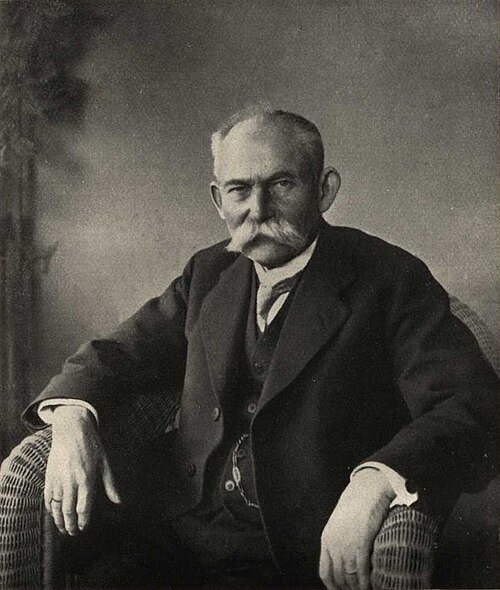
- Date of Birth: April 16, 1857
- Born City: Gräfentonna, Thuringia
- Born State/Country: Germany
- Parents: a Pfarrer (pastor) in Gräfentonna, & wife.
- Date of Death: January 3, 1930
- Death City: Würzburg
- Death State/Country: Germany
- Education:
Gymnasium Ernestinum, Gotha, 1869-74; study at Jena, 1874-7; Ph.D., Tübingen, 1878; Phil. Habil. (ancient history), Leipzig, 1898.
- Dissertation:
“Beiträge zur Quellenkritik des Quintus Curtius Rufus” (Ph.D., Tübingen, 1878); “Studien zur Entwickelung und theoretischen Begründung der Monarchie im Altertum” (Phil.Habil., Leipzig, 1898).
- Professional Experience:
Teacher, Gymnasium Ernestinum 1880-97; extraordinarius, Leipzig, 1902-3; ordinarius, history, Würzburg, 1903-29; corr. memb., Göttingen Academy of Sciences, 1919 (possibly 1927).
- Publications:
Forschungen zur Geschichte Alexanders des Großen (Stuttgart: W. Kohlhammer, 1887); “Alexander der Große und der Hellenismus,” HZ 74 (1895) 1-230; Studien zur Entwickelung und theoretischen Begründung der Monarchie im Altertum (Munich: R. Oldenbourg, 1898); “Die universalhistorische Auffassung in ihrer besonderen Anwendung auf die Geschichte des Altertums,” HZ 83 (1899) 123 ff; Die antike Idee der Oekumene in ihrer politischen und kulturellen Bedeutung: Akademische Antrittsvorlesung (Leipzig: B. G. Teubner, 1903); Theodor Mommsen (Leipzig: B. G. Teubner, 1904); Geschichte des Hellenismus. Erster Band: Die Grundlegung des Hellenismus (Leipzig: B. G. Teubner, 1901; 2nd ed. 1917); Geschichte des Hellenismus. Zweiter Band: Das Wesen des Hellenismus (Leipzig/Berlin: B. G. Teubner, 1909; 2nd ed., 1926); Das geschichtliche Wesen und Recht der deutschen nationalen Idee (Munich: C.H. Beck, 1916); Weltgeschichte, Antike und deutsches Volkstum,(Leipzig: Welcher, 1925).
- Notes:
While still in his Gymnasium Julius Kaerst developed a keen interest in history. He pursued his interest, along with philology and philosophy at Jena, where he studied under Rudolf Schöll (1844-93), Carl Nipperdey (1821-75), the historian Wilhelm Adolf Schmidt (1812-87), Erwin Rohde (1845-98), and Rudolf Eucken (1846-1926). However, the historian and Orientalist Alfred von Gutschmid (1831-87)—who arrived in Jena in 1876 and encouraged Kaerst to focus his research on ancient history—was a particularly formative influence. When Gutschmid moved to Tübingen, Kaerst accompanied him in 1877 and wrote his doctoral thesis (supervised by Gutschmid) on the source criticism of Quintus Curtius Rufus. Kaerst went on to study in Berlin, attending lectures by Adolf Kirchhoff (1826-1908), Johannes Vahlen (1830-1911), the historian and palaeographer Wilhelm Wattenbach (1819-97), the historian Karl Wilhelm Nitzsch (1818-80), Johann Gustav Droysen (1808-84), and the historian Theodor Mommsen (1817-1903). He passed his qualification exams for teaching school in 1880 and after a year moved to the Gymnasium Ernestinum, his alma mater, where he would serve for the next 18 years. Upon the death of Gutschmid, in 1887, he lost interest in teaching at the secondary level and devoted himself to attaining his habilitation at Leipzig. Once he became professor at Wurzburg, he devoted himself to his research program.
Kaerst developed three areas of interest over the course of his career. In his youth under the influence of Gutschmid, he studied the figure of Alexander the Great and Hellenism. His early monograph and subsequent article in HZ addressed Alexander from a Romantic nuanced viewpoint rather than the Enlightenment viewpoint of J.G. Droysen’s (1808-84) histories of Alexander and his successors, which applied to Alexander the “great man” theory. Droysen was also influenced by Hegel’s Idealism and by the Romantic movement sweeping Germany. Arguing that that the historian must not only relay and analyze facts but to depict the entire character and culture of the age in which his subject lived, Kaerst took pains to present Alexander within the character of the Hellenistic Greeks.
By the time of his habilitation, he had enlarged his perspective to the study of monarchy in Greek politics and philosophy as Greece became subsumed in the Roman Empire. He took the universal-historical concept employed by the great historians Leopold von Ranke (1795-1886), who preferred empirical sources to literary accounts, and B.G. Niebuhr (1776-1831) whose accounts of Roman politics and economy are evident in his early essay “Die universalhistorische Auffassung in ihrer besonderen Anwendung auf die Geschichte des Altertums” (1899) specifying the application of universal historicism to vie Greek and Roman history in conjunction with other regions and eras. He embarked on his universal history (Universalgeschichte) of Hellenism (1901–1909) and though he was able to revise and enlarge the first two volumes, he died before completing the third.
His comparative study of regions and time periods led him to seek historical sources for German nationalism. From the outbreak of the First World War onwards, Kaerst focused on the emergence of nation-states in Europe and in particular on the “German Question.” The character of the nation was formed by the Reformation and Idealism. The creation of the Reich in 1871 combined Prussian notions of imperialism with the freedom and richness of German culture. Kaerst connected ancient history and the German character in his final book, Weltgeschichte, Antike und deutsches Volkstum.
- Sources:
Joseph Vogt, Gnomon 6 (1930) 238-40; Joseph Vogt, Universalgeschichte: Abhandlungen von Julius KaerstStuttgart: W. Kohlhammer, 1930) vii–xx; https://de.wikipedia.org/wiki/Julius_Kaerst;
- Author: Ward Briggs