
All Scholars
KAIBEL, Georg
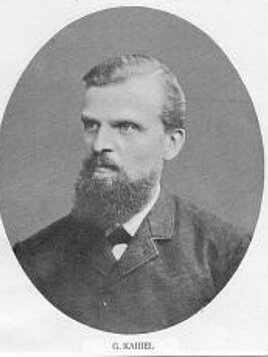
- Date of Birth: October 30, 1849
- Born City: Lübeck
- Born State/Country: Germany
- Parents: Friedrich, a Musikalienhändler (music dealer) & Louise Helene Meyer K.
- Date of Death: October 12, 1901
- Death City: Göttingen
- Death State/Country: Germany
- Education:
Katharineum, Lübeck, through 1868; study at Göttingen, 1868–9, Bonn, 1869-72; study at Archeological Institute, Rome, 1873-4; Ph.D. Bonn, 1981; Phil. Habil., Göttingen, 1878.
- Dissertation:
“De monumentorum aliquot Graecorum carminibus” (Ph.D., Bonn, 1871).
- Professional Experience:
State teaching examination, 1872; Stipendiary, German Archaeological Institute in Rome, 1872-4; probationary teaching year, Elberfeld, 1874; teacher, Askanisches Gymnasium, Berlin, 1875-8; extraordinarius, Breslau, 1879-81; ordinarius, Rostock, 1881–3; Greifswald, 1883-5; Strasbourg, 1886-97; Göttingen, 1897-1901; co-editor, Hermes, 1882-1901; memb. Göttingen Society of Sciences, 1897.
- Publications:
Books:
Epigrammata Graeca ex lapidibus conlecta (Berlin: Reimer, 1878), supplement, RhM 34 (1879) 181-213; Philodemi Gadarensis epigrammata. (Greifswald: Kunike, 1885); Athenaei Naucratitae Dipnosophistarum libri XV, 3 vols. (Leipzig: Teubner, vol. I 1887, vol. II 1888, vol. III 1890); Inscriptiones Graecae XIV: Inscriptiones Siciliae et Italiae. (Berlin: Reimer, 1890); Aristoteles: Vom Staate der Athener. Trans. with Adolf Kiessling (Berlin: Weidmann, 1891); Aristotelis Ἀθηναίων πολιτεία, ed. with U. von Wilamowitz-Moellendorff (Berlin: Weidmann, 1891; 3rd ed., 1898); Stil und Text der Πολιτεία Ἀθηναίων des Aristoteles (Berlin: Weidmann, 1893); Cl. Galeni Protreptici quae supersunt (Berlin: Weidmann, 1894); Sophokles Elektra (ed.) Sammlung wissenschaftlicher Commentare zu griechischen und römischen Schriftstellern (Leipzig: B. G. Teubner, 1896); De Sophoclis Antigona (Göttingen: Dieterich, 1897); Die Prolegomena Περὶ κωμῳδίας., Abhandlungen der Königlichen Gesellschaft der Wissenschaften zu Göttingen, philol.-hist. Kl., N.F. 2.4 (Berlin: Weidmann, 1898); Comicorum Graecorum fragmenta, vol. 1, fasc. 1: Doriensium comoedia, mimi, phlyaces, Poetarum Graecorum fragmenta, vol. VI (Berlin: Weidmann, 1899); De Phrynicho sophista (Göttingen: W. F. Kaestner, 1899).
Articles:
“Supplementum epigrammatum Graecorum ex lapidibus conlectorum," RhM 34 (1879) 181–213; “Tituli Phocici et Boeotici,” Hermes 8 (1874) 412-30; Sententiarum liber I–VIII, Hermes 15 (1880), 449-64; 17 (1882), 408-24; 19 (1884), 246-53; 22 (1887), 497-514; 25 (1890), 97-112; 28 (1893), 40-64; 30 (1895), 429-46; 36 (1901) 606-9; “Antike Windrosen,” Hermes 20 (1885) 579-624; “Dionysios von Halikarnass und die Sophistik,” Hermes 20 (1885) 497-513; “Xenophons Kynegetikos,” Hermes 25 (1890) 581-97; “Johannes Schweighäuser,” ADB 33:345-51; “Aratea,” Hermes 29 (1894) 82-123; articles on Greek comic poets, in RE, vols. 1–4 (Stuttgart: Metzler, 1894–1901); “Die Vision des Maximus,” Sitzungsberichte der Königlich Preußischen Akademie der Wissenschaften zu Berlin (1895) 781-92 . “Zu den Epigrammen des Kallimachos,” Hermes 31 (1896) 264-70; “Cassius Longinus und die Schrift περὶ ὕψους,” Hermes 34 (1899) 107-32; “ΔΑΚΤΥΛΟΙ ΙΔΑΙΟΙ,” Nachrichten von der Königlichen Gesellschaft der Wissenschaften zu Göttingen, phil.-hist. Kl. (1901) 488-518.
Complete bibliography. W. Radtke BBJ 123 (1904) 15–62.
- Notes:
Georg Kaibel’s tragically short but brilliant career began with his training at Bonn by the philologists Franz Bücheler (1837-1908) and Hermann Usener (1834-1905), who in 1871 recognized their student’s abilities by awarding him a prize for collecting Greek inscriptions. A portion of the result of his investigation became part of his doctoral dissertation. While a stipendiary at the German Archaeological Institute in Rome, he traveled to Greece in 1873 with the great Berlin Hellenist Ulrich von Wilamowitz-Moellendorff (1848-1931) with whom he began a long and productive professional collaboration. Wilamowitz introduced Kaibel to his father-in-law, the historian Theodor Mommsen 1873 with whom Kaibel also developed a long association. Mommsen enlisted Kaibel to edit a volume of Greek inscriptions from Italy and Sicily for his Inscriptiones Graecae and in 1882 named him a co-editor of Hermes.
Kaibel taught at the secondary level until he completed his habilitation in 1878, perhaps with his Epigrammata Graeca ex lapidibus conlecta (1878). This volume contained over 1200 epigrams covering ten centuries. In his thirties, he quickly rose as professor at Breslau, Rostock, Greifswald and Strasbourg before being called to Göttingen in 1897. His specialty was Greek epigraphy, beginning with his student prize essay, through his habilitation and finally to his contribution to IG. Though there have been many new discoveries since his IG volume, it is still a standard reference.
Kaibel’s work apart from epigraphy shows a remarkable range and influence. He imposed page references in his three-volume edition of Athenaeus which are still the standard for notation. When the papyrus containing Aristotle’s Constitution of Athens was discovered in 1891, Kaibel and Wilamowitz edited the text. Kaibel later wrote a commentary with an aim to proving the textual authenticity of the constitution. He wrote a long and significant series of philological notes in Hermes. From 1890 he worked on the Greek comic fragments within Wilamowitz's planned collection of the fragments of all Greek poets. Kaibel completed only the first fascicle (Dorian comedy, mime, phlyakes, 1899) before his death. He also wrote articles on comedy for the first volumes of RE. Later collections of the comic fragments have superseded his work. His edition of the Electra (1896) was, in the words of Sandys, “one of the finest of the works” he produced. This and his Antigone (1897) sparked further investigations into these plays by other scholars. He also showed interest in the Second Sophistic leading him to important work on Dionysius of Halicarnassus, Cassius Longinus, Phrynichus and Galen's Protreptikos.
Although Kaibel is remembered primarily as an epigraphist, he did not limit himself to a narrow field but made durable contributions to the study of Greek poetry, prose, and drama. By gaining the respect and friendship of Wilamowitz and Mommsen, he was able to contribute to two major collective German projects. He produced a reliable text of the newly discovered Constitution of Athens, an edition of Athenaeus, and a great commentary on the Electra. Had his early death at 51 not halted his planned work on Greek comedy his contributions to our understanding of the genre would have been even more substantial.
- Sources:
F. Leo, Göttingen Mitteilungen (1902); W. Radtke, BBJ 123 (1904) 15-65; Sandys, 154-5; Gerhard Baader, NDB 11 (1977) 31-2.
- Author: Ward Briggs