
All Scholars
LORD, Mary Louise
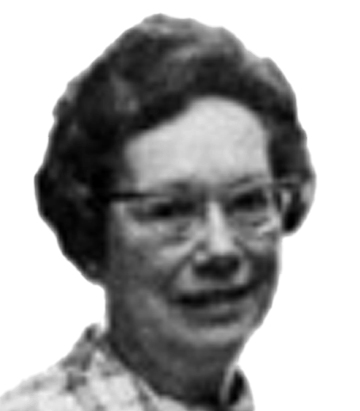
- Date of Birth: June 11, 19116
- Born City: Buffalo
- Born State/Country: NY
- Parents: Walter Louis & Ruth E. Werling Carlson
- Date of Death: August 5, 2009
- Death City: Louisville
- Death State/Country: CO
- Married: Albert Bates Lord, August 24, 1950.
- Education:
B.A., U. of Buffalo, 1938; A.M., Cornell, 1939; Ph.D., 1942.
- Dissertation:
“Roman Examples in the Latin Christian Apologists” (Cornell, 1942).
- Professional Experience:
Instr., Elmira College, 1941-2; asst. prof., Bates College, 1942-7; lectr. Latin & anc. Hist., Wellesley, 1947-50; asst. prof., humanities, Boston U., 1950-4; assoc. prof., Connecticut College for Women (now Connecticut College), 1961-9; prof., 1969-81; pres., CANE, 1977-8.
- Publications:
“Splendeat Usu.” CO 24 (1947) 71-2; “Roman Examples of Fortitude in the Latin Christian Apologists,” CP 43 (1948) 93-104; “Withdrawal and Return. An Epic Story Pattern in the Homeric Hymn to Demeter and in the Homeric Poems,” CJ 62 (1967) 241-8; “Dido as an Example of Chastity. The Influence of Example Literature,” Harvard Library Bulletin 17 (1969) 22-44; “Petrarch and Vergil's First Eclogue: The Codex Ambrosianus,” HSCP 86 (1982) 263-76; “A Commentary on Aeneid 6: Ciones de Magnali, not Nicholas Trevet,” M&H 15 (1987) 147-60; “Boccaccio's Virgiliana in the Miscellanea Latina,” IME 34 (1991) 127-97; “Virgil's Eclogues, Nicholas Trevet, and the Harmony of the Spheres,” MS54 (1992) 186-273; “The Commentary on Virgil's Eclogues by Benvenuto da Imola: a Comparative Study of the Recollectiones,” Euphrosyne 22 (1994) 373-401; Albert Bates Lord, The Singer Resumes the Tale (ed.) (Ithaca, NY: Cornell U. Press, 1995); “The Use of Macrobius and Boethius in Some Fourteenth-Century Commentaries on Virgil,” IJCT 3 (1996-7) 3-22; “Benvenuto da Imola's Literary Approach to Virgil's Eclogues,” MS 64 (2002) 287-362.
- Notes:
Mary Louise Lord began her undergraduate education at her hometown University of Buffalo after graduating as valedictorian of her high-school class. She graduated summa cum laude and went on to graduate work at Cornell. After teaching at Elmira and Bates Colleges during the war, she became a lecturer at Wellesley College in 1947. On the way to a classics conference, she shared a cab with the Harvard professor of Slavic and comparative literature Albert Bates Lord (1912-91), whom she married. The year after their marriage she accompanied him on a research trip to Yugoslavia where he continued his work in the light of his friend and mentor Milman Parry (1902-35). His volume A Singer of Talesappeared in 1960 and expanded his research to cover the phenomena of oral performance and composition. In addition to his study of Homeric formulae in the light of South Slavic epic, he also examined Beowulf and Gilgamesh. Throughout the period of 1950-69, she accompanied him on travels and supported him editorially and materially in his work.
Throughout this period, she was also developing her resources on Servius, the fourth/fifth-century commentator on Virgil. After a study of a recurrent story in the Homeric corpus, she turned to her thoughts on Virgil’s poems and in 1987 to the fourteenth-century commentators on Servius, the Dominican monk Nicholas Trevet (ca. 1258-1328), Zono de Magnali of Florence, who lectured on Virgil I 1319-21, and the Bolognese Benvenuto da Imola (1320-88). She contributed to the Catologus Translationum et Commentatiorum for the Pontifical Institute of Medieval Studies.
Following the untimely death of her husband she completed and edited his manuscript of The Singer Resumes the Tale in 1995. The private library of Mary Louise and Albert Lord was donated to the University of Missouri in 2010 through the agency of Albert Lord’s student John Foley (1947-2012), a Classics and English Professor well known for his work on folk epic.
- Sources:
DAS 8th ed., 3; WhWhAmW (1971).
- Author: Ward Briggs